“For just as each of us has one body with many members, and these members do not all have the same function, so in Christ we, though many, form one body, and each member belongs to all the others.” – Romans 12:4–5
There was something profoundly holy about that packed double-wide trailer.
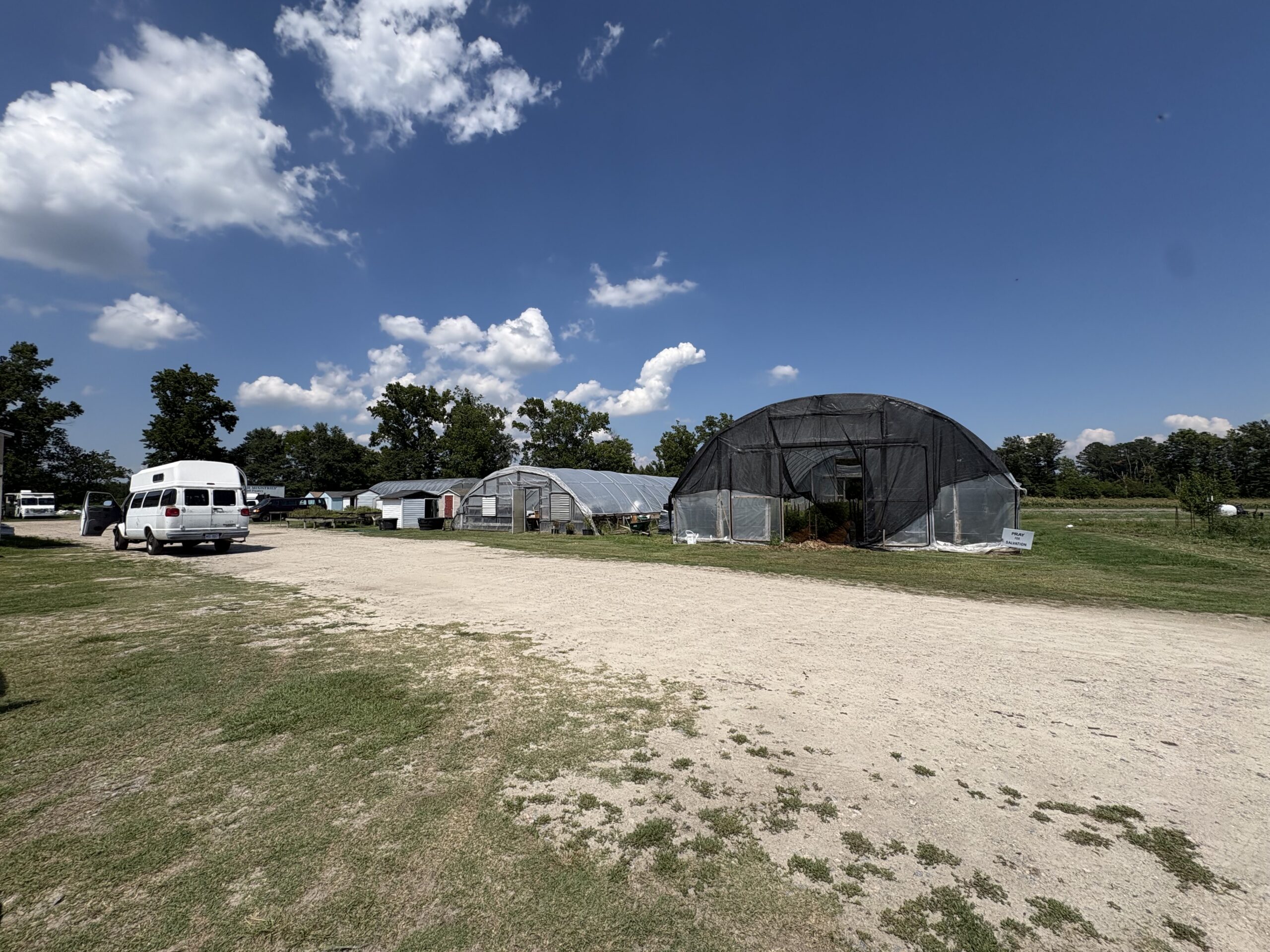
On one of the hottest days of a mid-North Carolina summer, I found myself driving down long stretches of eastern North Carolina back roads toward Conetoe Family Life Center in Tarboro. The fields seemed to stretch endlessly in every direction, interrupted only by clusters of trees, old farmhouses, and weathered barns. Weeks without rain had left the land dry, and I couldn’t help but wonder what this prolonged drought had meant for the farmers who depend on this soil and the neighbors who rely on its harvest.
By the time I pulled onto the twenty-five acres of Conetoe Family Life Center, the July heat felt heavy and still. Beyond the rows of vegetables, volunteers moved throughout the farm, tending to the work happening all around them. I made my way into a packed-out double-wide trailer, where fifteen to twenty pastors, faith leaders, and community members sat shoulder to shoulder in chairs forming a large circle that spilled into the next room.
There was barely room to move.
And somehow, it felt like there was room for everyone.
Some of those gathered had participated in the Abundant Life Cohort, an initiative of Partners in Health and Wholeness, while others had come because they were curious about the work taking shape in Nash and Edgecombe Counties. Together, they represented more than ten churches across the region- different denominations, different histories, different communities.
Yet no one came to promote their own ministry.
They came to listen.
They came to learn.
They came to ask a shared question:
How can we become a source of healing for our hurting community together?
As I looked around that crowded trailer, I couldn’t help but wonder if this is what the kingdom of God often looks like.
Not polished conference rooms.
Not impressive church buildings.
Not congregations working in isolation.
But pastors and neighbors gathered shoulder to shoulder in a humble trailer on a farm, believing that the burdens their community carries are too heavy for any one church to bear alone.
Rev. Richard Joyner knows something about paying attention to what God has already placed before us.
After years of serving as pastor of Conetoe Chapel Missionary Baptist Church, Rev. Joyner grew weary of officiating funeral after funeral for neighbors whose lives had been shaped by chronic disease, violence, trauma, and preventable illness. Rather than focusing on what his church lacked, he began looking for what God had already provided.
He looked around.
And he saw farmland.
What began as a vision to address the health and wellbeing of his community became Conetoe Family Life Center—not simply a farm, but a ministry of healing. A place where healthy food is grown, young people are nurtured, relationships are strengthened, and neighbors experience belonging.
That same posture shaped the partnership that emerged through the Abundant Life Cohort.
The Abundant Life Cohort equips churches across North Carolina to become hubs of behavioral health and wellbeing—communities rooted in healing, connection, and holistic flourishing. Through this process, churches are invited to listen deeply to their communities, recognize the gifts already present, build meaningful partnerships, and discern how God is calling them to respond.
The goal is not for every congregation to do the same thing. The goal is for each church to faithfully respond to the unique needs and strengths of the community God has placed them within.
The gathering at Conetoe Family Life Center was a beautiful example of that vision coming to life.
Through the cohort process, Conetoe Chapel Missionary Baptist Church, in partnership with Conetoe Family Life Center, joined with Shiloh Missionary Baptist Church and Thornes Chapel Missionary Baptist Church to imagine what was possible when they worked together.
Rather than creating separate efforts, they chose partnership.
Together, they listened to their neighbors. They named the realities facing their community—gun violence, loneliness, trauma, grief, chronic disease, and isolation. They identified the gifts already present and asked what might become possible if they leveraged their collective strengths, relationships, resources, and ministries.
Together, they began imagining what it could look like to become a network of churches committed to nurturing healing of mind, body, and spirit throughout Nash and Edgecombe Counties.
Like the members of one body described in Romans 12, each congregation brought something unique.
Their differences did not divide them.
They strengthened them.
Later in the meeting, Rev. Joyner quietly reflected,
“It makes sense that all of us are living in survival because we’ve all been living in some kind of threat.”
The room fell silent.
There was no rush to fix the conversation. No quick solutions. Just a shared willingness to tell the truth about the burdens their communities have been carrying.
Then someone spoke words that have stayed with me ever since:
“No silos. We have to do this together.”
In that moment, Paul’s words in Romans were no longer an abstract theological idea.
“We, though many, form one body, and each member belongs to all the others.”
I realized I wasn’t simply witnessing a community meeting.
I was witnessing the body of Christ remembering itself.
What I witnessed that afternoon in eastern North Carolina is one example of what is happening across our state.
Over the past two years, fifty-three congregations spanning twenty-six North Carolina counties have participated in the Abundant Life Cohort. Across denominations, regions, and community contexts, churches have listened to their communities, built partnerships, discerned where God is already at work, and imagined new ways to become places of healing and wellbeing.
No two communities are the same, and no two hubs of behavioral health and wellbeing will look exactly alike. But one truth continues to emerge: the work of healing is too important for any one church to carry alone.
Standing on that farm, I had the joy of witnessing one of those healing hubs firsthand.
I left filled with hope.
Hope because I watched churches choose collaboration over competition.
Hope because I saw pastors more interested in serving their neighbors than protecting their own ministries.
Hope because I witnessed congregations recognize that the gifts of another church do not diminish their own, but instead make the whole body stronger.
And hope because I was reminded that while it is true that hurt people hurt people, it is equally true that healed people heal people.
This September, another cohort of congregations will begin this journey together. I cannot wait to witness the ways the body of Christ continues to come together across denominations, North Carolina counties, and community contexts.
I can’t wait to see more churches proclaim with both their words and their lives:
“No silos. We have to do this together.”
Our communities are hurting.
The Church has never been called simply to gather within sanctuary walls. We have always been sent beyond them—to notice where Christ is already present, to join the work the Spirit is already doing, and to bear one another’s burdens as one body.
As I think back to that July afternoon, I don’t remember the heat nearly as much as I remember the hope.
Maybe the kingdom of God looks a little more like a packed double-wide trailer on twenty-five acres of eastern North Carolina farmland than we often imagine. A place where churches choose partnership over isolation, where healing begins to take root, and where the body of Christ remembers that it belongs to one another.
